At the end of February, three students from the Medical University of Innsbruck (MUI) participated in the NeurotechEU Winter School in Clinical Neurotechnology in Cluj, Romania. The program brought together students from universities across Europe, creating an international environment for learning and exchange.
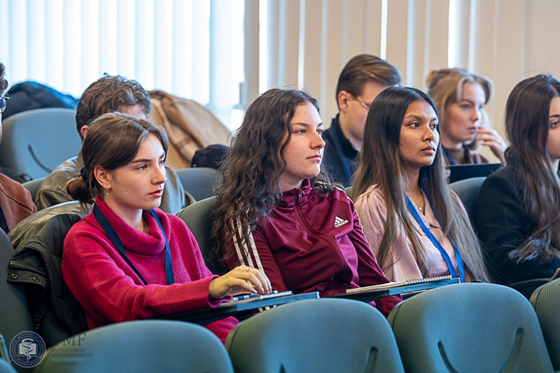
Among the participants was Rebecca Winkler, a third-year student in MUI’s Bachelor’s program in Molecular Medicine. Eager to complement her theoretical background in neurology with a stronger clinical perspective, she joined the program to deepen her understanding of the field. Below, she shares her experiences from the winter school.
‘The NeurotechEU Winter School on Clinical Neurotechnology offered an intensive, hands-on introduction to the intersection between neuroscience, medicine and technology. From Monday to Thursday, we immersed ourselves in topics ranging from neuroanatomy and semiology to EEG, eye tracking and neurorehabilitation systems. The programme therefore combined theoretical foundations with practical applications.’
Neuroanatomy & VR
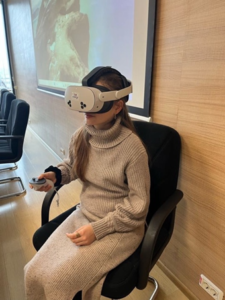
‘The week began with an introduction to neuroanatomy. We had the opportunity to dissect real human brains and explore their structures and pathologies firsthand. Additionally, we used VR headsets to examine the human body in a fully immersive way. With them, we were able to virtually take apart structures and observe them in detail. It was fascinating to see how the host university UMF integrates VR into medical education.’
Clinical Applications
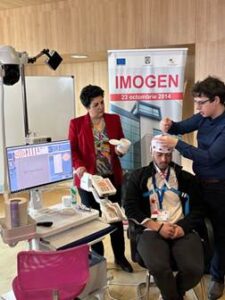
‘After diving into anatomy, the programme transitioned into semiology and clinical neurology. We explored EEG and eye-tracking systems, with one participant even volunteering for a live EEG session. This practical exposure allowed us to better understand how neurological diagnostics are applied in real clinical settings. Moreover, we were also able to try out two different eye-tracking systems ourselves. Through VR Headsets we further looked at real-life patient cases, examining them for neurological dysfunctions and pathologies. Thanks to that, it was easier to grasp how patients really are to be examined after having undergone e.g. a stroke. Especially as a Molecular Medicine student it was very insightful to see the clinical applications, which we normally do not get to see in action.
Moreover, we also had a live online session with the product manager of RGS Ecosystems, who introduced us to their neurorehabilitation systems. We were able to test the RGS system ourselves – both on TV ‘s and even our own phones – which let us experience the way patients train with these systems.’
More than an academic programme
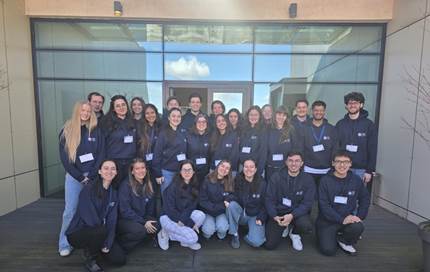
‘Overall, the NeurotechEU Winter School turned out better than I could have ever imagined. From insight about cutting-edge science, to clinical aspects, innovative technology and genuine human connection. It was not just an academic programme, but an experience that will stay with us for a long time. This way, we found new friends from all over the world – waiting to someday meet up again somewhere else.’
Also interested in expanding your horizon? Check out current opportunities under the tab ‘Events’.
Image credit: Rebecca Lara Winkler