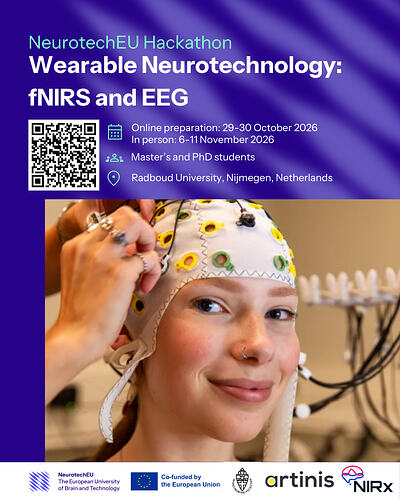
Discover how wearable neurotechnology is transforming neuroscience, healthcare, and human-computer interaction. In this hands-on international hackathon, you will collaborate with students from different disciplines, explore cutting-edge brain monitoring technologies, and develop innovative solutions to real-world challenges using EEG and fNIRS. Join us to gain practical experience, expand your network, and contribute to the future of neurotechnology.
About
Wearable neurotechnology is increasingly used in neuroscience, rehabilitation, human factors research, neuro-ergonomics and brain-computer interfaces. Among the most widely adopted wearable methods are Electroencephalography (EEG) and Functional Near-Infrared Spectroscopy (fNIRS).
In this hackathon, you will work in a group to design new applications for these techniques. You will also receive lectures that introduce both techniques from physiological principles to practical application. You will learn how brain activity can be measured through electrical and haemodynamic signals and how the two modalities.
Working in interdisciplinary teams, students are challenged to answer a practical question and design a new application using wearable neurotechnology and to demonstrate, through experimentation and data analysis, how EEG, fNIRS, or a combination of both could provide a meaningful solution.
The hackathon follows a complete neurotechnology workflow:
- Understanding EEG and understanding fNIRS
- Designing an experiment, based on a real-world problem
- Acquiring wearable neuroimaging data
- Processing and analysing data
- Interpreting findings
- Evaluating multimodal approaches
- Presenting scientific results
Learning outcomes
After completion, participants will be able to:
Knowledge
- Explain the physiological principles of EEG and fNIRS.
- Compare strengths and limitations of both modalities.
Skills
- Design a wearable neurotechnology application.
- Acquire high-quality EEG and fNIRS recordings.
- Assess signal quality and identify artefacts.
- Analyse EEG and fNIRS data using open-source tools.
- Evaluate the suitability of different neurotechnology solutions.
Professional Competences
- Translate a real-world challenge into a new application
- Work effectively in interdisciplinary teams.
- Develop an evidence-based neurotechnology concept.
- Pitch scientific and technological solutions to a larger audience.
Details
Format: Erasmus+ Blended Intensive Program
Duration: Online preparation (29-30 October 2026); In person Friday, 6 – Wednesday, 11 November 2026
Organisation: academic staff from Radboud University, Boğaziçi University and Medical University of Innsbruck; and staff from the companies Artinis Medical Systems BV and NIRx Medical Technologies
Eligibility and application: Master’s and PhD students from a wide range of academic backgrounds are encouraged to apply. Working in interdisciplinary teams is a key part of the experience, providing opportunities to learn from different perspectives and areas of expertise.
Application
Master’s and PhD students of the Medical University of Innsbruck are welcome to apply by sending the following documents to neurotecheu@i-med.ac.at
- CV
- Motivation letter
- Endorsement letter (for PhD/Postdoc, from your supervisor)
- Transcript of records (Master students)
Application deadline: 04 October, 23.59.
Financial support will be available for the selected participants.